
As I look forward to my first state pension payment landing in my bank account tomorrow, I’m thinking about the wise advice about financial economy that I received from my grandma when my grandpa was about to retire.

As I look forward to my first state pension payment landing in my bank account tomorrow, I’m thinking about the wise advice about financial economy that I received from my grandma when my grandpa was about to retire.

 Actually, there are very many reasons that I love public libraries, and I’ve written about them before on this blog. I’ve also written two short stories inspired by public libraries, published in my flash fiction collection, Quick Change. But each January, I have an extra reason to be glad they exist: the annual issue of author payment statements for books borrowed by public library members.
Thanks to a scheme called Public Lending Right (PLR), in the UK, authors get paid when public library members borrow their books – something I didn’t know until I became an author myself.
Also in receipt of PLR are illustrators, translators, editors, and audiobook narrators, provided their names appear on the book’s title page. (See also Sarah McInture’s excellent #PicturesMeanBusiness campaign for recognising illustrator’s contributions to books).
The amount per book, currently 12.4p per loan, is shared between those who created it. Thus for a novel entirely written by a single author, the author claims 100%, but for an illustrated book, the payment will be split in appropriate proportions between author and illustrator. Of course, that’s a lot less earned per book than if someone actually bought it – but it’s surprising how quickly the borrows mount up into a significant sum and a useful bonus.
To receive PLR for a book, the author or publisher has to register their claim online, which the British Library will verify. (If you’re an author not yet registered, you can do so here: https://www.bl.uk/services/plr#registration_)
Other countries run similar schemes, but here in the UK, the British Library adminsters the distribution of PLR royalties, using £6.6m provided by the Department of Digital, Culture, Media and Sport. That may sound like a vast sum, but there are an awful lot of books and authors who must share it. This year, my PLR share is my best ever, hurrah!
I used to wonder how on earth the British Library managed to keep track of all the borrows nationwide, but I’ve since discovered that they monitor only a representative selection of libraries. Your payment depends partly on luck: whether your books are stocked in the libraries in their sample. However, we have no way of knowing which those libraries are, and the selection changes every year.
But PLR statements do tell us how many times each of our books has been borrowed in its various formats, which is interesting to know. In 2024-2025, my most borrowed books were:
#1 Death at the Old Curiosity Shop

#2 Murder at the Vicarage (Sophie Sayers #2)

#3 Driven to Murder (Sophie Sayers #9)

So if you’ve ever had any qualms that borrowing books from public libraries deprives authors of income, you can stop worrying.
The annual PLR statements make authors very happy!
By coincidence, my first public event of 2026 will be at Bath Central Library, alongside a fantastic group of authors and publishers selling their books at the Local Authors and Small Publishing Fair as part of the Bath & North East Somerset (B&NES) Festival of Libaries. Between 11am and 3pm, visitors can meet authors and publishers informally on their stands, where we’ll be selling signed copies of our books. With tea and cake also on hand, it’ll be a relaxed and inspiring day in a creative environment. I’m really looking forward to meeting lots of readers as well as local author friends.
***Free admission***, so you can spend your money on books, tea and cake instead!

January definitely calls for cosy reads – and so far this month I’ve picked two from my collection of British Library Crime Classics. So that’s another reason to love the British Library – they publish mysteries first published during the Golden Age of Detective Fiction between the two World Wars. Some of the novels are better than others, as you’ll see from my reviews below, but they all have stunning covers, look beautiful on the shelf, and are giving a new lease of life to many authors too long out of print.
~~~~~
 Weekend at Thrackley by Alan Melville
Absolutely cracking Golden Age fare, and I raced through it. Classic isolated country house set-up featuring a fun assortment of vivid characters thrown together in intriguing circumstances. I confess I guessed one of the details revealed at the end, but that didn’t diminish my enjoyment.
Poignant detail that the central character is a young man at a loose end after serving in the First World War, battle-scarred but with no employable qualifications, as so many must have been, which made me extra glad that he arrived at a happy ending in the story.
Told with a light, wry touch – although narrated in third person, includes lots of witty throwaway and judgmental comments that added to the fun. The nostalgic cover illustration, taken from a vintage travel poster, is just right.
~~~~~
 Scarweather by Anthony Rolls
Well, this was an oddity. Although endorsed by Dorothy L Sayers, it broke many of the rules that apply to the genre. I wouldn’t even term it a murder mystery, as there was very little mystery about it. The sense of place, the characterisation, and the writing style were all great – but coming to expecting a rollicking good classic mystery, I felt shortchanged. Could have been very much better, and I’m puzzled as to why the author (and the original publisher) let it go as it is. A good structural editor, with a few strategic tips and tweaks, would have made it very much more satisfying. Shame.
~~~~~
Read more about the Golden Age of Detective Fiction in this post from my blog archive:
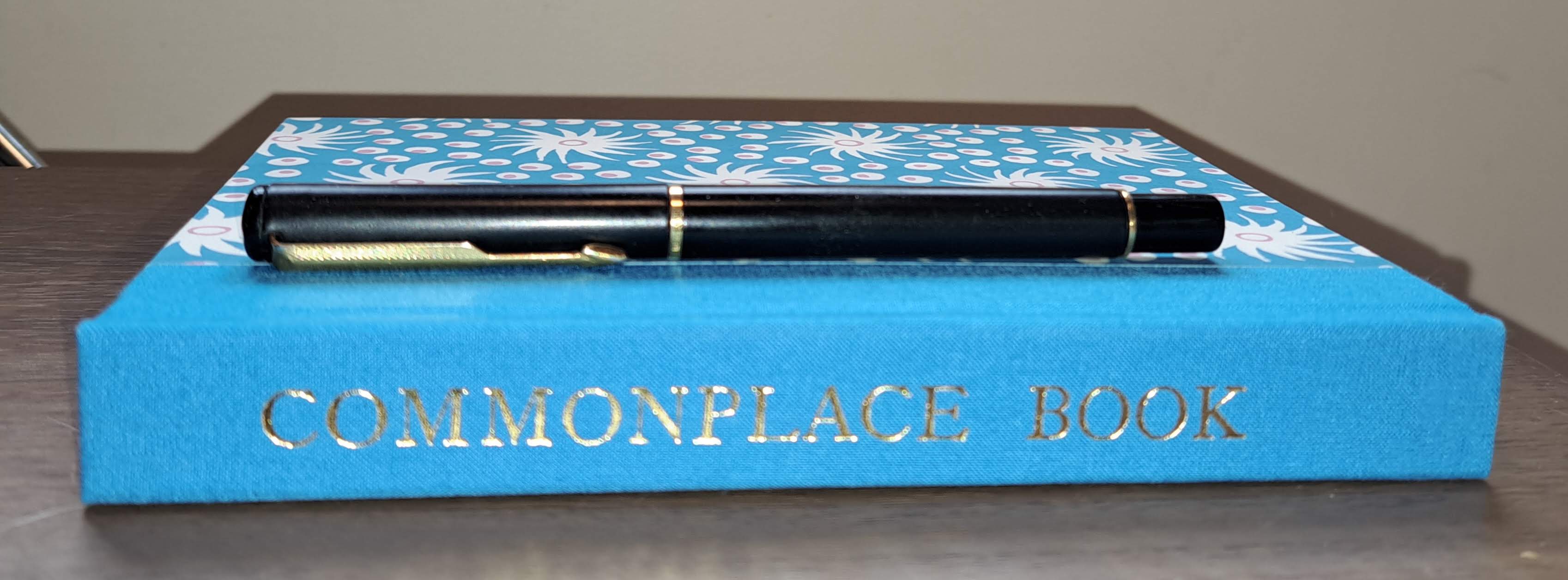
Forgive the contradiction in terms, but I’ve long mourned the decline of the commonplace book, so I was delighted to discover at a craft fair at Rodmarton Manor last autumn that local bookbinder Ursula Jeakins of Starsmead Bookbinding now creates beautiful volumes especially for that purpose.
While there’s been a surge of interest in journalling lately, the end products seem to be fancy versions of the desk diary or personal planner. They’re the jazzier descendant of the 1980s must-have accessory for executives, the Filofax.
Social media is full of ads for the dotted notebooks, pens, stencils, stickers .and washi tape (decorative Japanese masking tape) considered de rigueur for the curation of a modern journal. How do people find time to transform to-do lists into works of art? Perhaps they allocate hours to the activity in a neat grid in their journals.
The traditional commonplace book, on the other hand, for which you need only a notebook and pen, gets little airtime these days. Perhaps that’s because it’s less of a money-spinner for suppliers or dopamine source for buyers. For a commonplace book, you don’t need fancy effects. You just write down text extracts you’d like to preserve from whatever you’ve been reading. It’s the words that make the commonplace book worthwhile, not surface decoration.

Any striking piece of text qualifies for inclusion, whether taken from a book, a magazine or newspaper, or from online platforms. Your chosen quotes may be inspiring, provocative or enlightening. They may express original thoughts that especially resonate with you, or beliefs you’ve long held phrased in a new and beautiful way.
Long ago, when everyone wrote by hand and read only from the printed page, commonplace books were much more, er, common. To the literate classes, it was second nature to copy out prose or poetry that took their fancy. A good commonplace book distills into a single volume the best of what you’ve read. Even influential thinkers such as John Milton and Virginia Woolf also kept commonplace books.
A few years ago, I started keeping my own commonplace book in a notebook given to me by my best friend. The high-quality paper and hardback binding demanded a special purpose. Stationery addicts like me tend to hoard beautiful notebooks – and then end up writing mostly on scrap paper, rather than despoil their pristine pages. I was determined not to add this notebook to my guilty stockpile of blanks.
The cover of my current commonplace book is a facsimile of a book by Enid Blyton, not renowned for her eloquence, but she helped turn generations of children into avid readers, including me.

It’s intriguing to flick back through my commonplace book to see whose words of wisdom I’ve preserved over the years. They come from the likes of novelistsBarbara Pym and Philip Pullman, travel writers Jan Morris and Patrick Leigh Fermor, artists Leonardo da Vinci and David Hockney, and from Hawkesbury’s own stable of authors, John Ruthven, in an extract from his excellent memoir The Whale in the Living Room.
Confession time: I seldom go back to read what I’ve recorded there, but scientific evidence shows the act of writing something helps you process its essence and embed it in your subconscious. Perhaps I should start writing down where I park my car or leave my glasses so that I can find them again.
So, while the nights are still long, and it’s easier to find time to curl up by the fireside with a good book than inspring or summer, try starting your own commonplace book and gain extra mileage from your winter reading.
(This article first appeared in the January 2026 edition of the Hawkesbury Parish News.)
Huge thanks to everyone who bought a copy of my latest mystery novel, Death at the Village Christmas Fair, helping it reach bestseller status. Of course, being a Christmas book, it will now rapidly plummet down the charts, but if you’re looking for a seasonal read for January, you might like to try these books from my back catalogue, each of which starts in January and finishes around Valentine’s Day:


Murder at the Well is the fourth Sophie Sayers mystery, and Wicked Whispers at St Bride’s is the third Gemma Lamb, but you don’t need to have read the earlier books for these to make sense.
Meanwhile, I’m having a quiet week, finally catching up with myself at my desk – which doesn’t mean just writing. There’s also always admin to do.
For example, today I had to submit some information and images to event organisers, ready for my appearance at the London Book Fair in March and the London Festival of Writing in June. (See event details and links in the right hand sidebar.) Those events feel like a long way off just now, but I’m sure they’ll come round fast.
Busy as I am, I still make sure I squeeze in at least an hour of reading each day, usually in the morning after breakfast. I’ll add below my brief reviews for the last three books I read in 2025. By chance, I’ve met the authors of all three – Judith in a Zoom call, Joly as a student of the course I teach for Jericho Writers, and Amon Chizema when he introduced hmself at last year’s Troubador Self Publishing Conference. All three books are great examples of self-publishing done well, and I really enjoyed reading all three.
(Click the titles to go to each book’s sales page on Amazon.)
 Burnt Siena by Judith May Evans
Having visited Siena as a tourist a long time ago, I was keen to read this book to provide some insights into its medieval history, and soon found myself swept up in an epic tale of mercenaries fighting for power and influence, affecting ordinary people throughout the region, in particular two childhood sweethearts torn apart by the conflict.
The detail was powerful and realistic, incorporating the merciless horror of the battles without ever becoming sensationalist. The characterisation is thoughtful and complex, and I particularly enjoyed the inclusion of the later St Catherine of Siena and her extraordinary take on faith, with walk-on parts for medieval writers Chaucer and Boccaccio in their roles as ambassadors for their respective rulers.
It’s a rollercoaster of a read in terms of the romantic thread, with a satisfying ending. Highly recommended.
 The Porcelain Poet by Joly Braime
What a joy! A gripping page-tuner that satisfies in so many ways – twisting plot, strong and believable characterisation, vividly described interesting settings, political overtones, historic atmosphere, told with knowing wit and charm. Very glad to learn that Harrison Catcliffe and friends will return for a third adventure. Highly recommended. (The first in this series, The Tin Face Parade, is also a terrific read.)
 The Land Remembers: Blood, Soil, and Survival by Amon Chizema
This is a beautiful, slow-burn story of one man’s struggle to sustain his African farm, in the face of diversity.
The name of the farm, Alkubelan, is thought to be an ancient name for the African continent – but even if I hadn’t known that, I’d still have thought it read like an allegory for the whole of Africa and even for the planet and humanity.
An inspiring example of how when greed and selfish desires are cast aside, humanity can work together for the common good. Highly recommended.
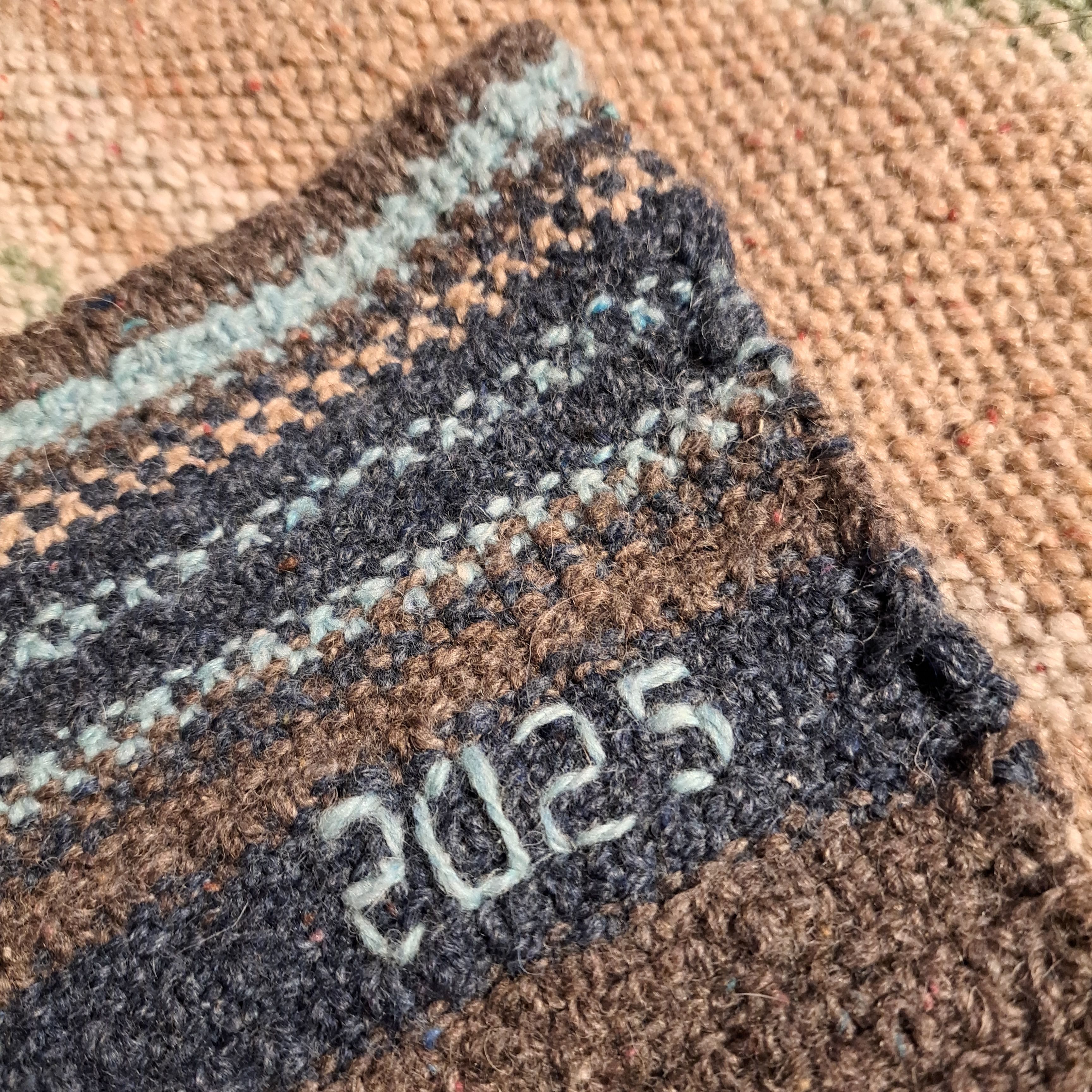
As I plan my writing and speaking schedule for 2026, I share my top tip for how to convince yourself you’re making the most of your time – and in the postscript share my completed temperature blanket for 2025.
In 1812, when John Letts, founder of the printing, bookbinding, and stationery business Letts of London, launched the first pre-printed diary, it was an overnight success. In the pre-digital era, this combined calendar and journal provided a revolutionary way of keeping track of past and future events in a single volume. The name Letts soon became synonymous with diaries. The company continued to expand its range of diaries long after John Letts had written his final entry.
In my last post before Christmas, I’d like to pay tribute to Iceland’s heartwarming Christmas tradition of Jólabókaflóð – when everyone gives each other books on Christmas Eve, before curling up by the fire to read them.
Continue reading “The Gift That Keeps On Giving: Reading for Pleasure”